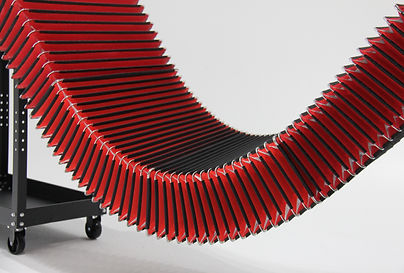
The Fold
Accordion performance installation
Dimensions variable
The Fold explores the relationship between folds, space and the body in contemporary art. A fold is neither fully closed nor completely open. It holds tension, movement and uncertainty within itself. Through repeated actions of folding and unfolding, the work suggests a spatial structure that is layered, unstable and constantly shifting.
In this project, the fold is not only a physical form, but also a metaphor for how space is experienced. It reflects the way boundaries are rarely fixed. Public and private, inside and outside, exposure and protection are not clearly separated, but overlap and press into one another. The fold becomes a threshold, a place where different states meet without being fully resolved.
I am interested in how the body responds to folded space. A folded surface can conceal, reveal, compress or open up. It changes how we look, move and position ourselves in relation to the work. The body is not simply placed in front of the object, but becomes part of the spatial condition created by it.
The work also considers the psychological dimension of folding. A fold can suggest memory, hesitation, protection or withdrawal. It can hold traces of pressure and transformation, like a surface that has been touched, moved or temporarily interrupted. In this sense, The Fold reflects on space not as a neutral container, but as something shaped by bodily experience, emotional tension and shifting boundaries.
Through this project, I want to question how a simple material gesture can become a way of thinking about contemporary life. The fold becomes a structure of ambiguity. It protects without sealing, opens without fully exposing, and allows space to remain active, layered and unresolved.
《The Fold》探讨当代艺术中褶皱、空间与身体之间的关系。褶皱既不是完全封闭的,也不是彻底敞开的。它自身承载着张力、运动与不确定性。通过不断折叠与展开的动作,作品暗示出一种层叠、不稳定且持续变化的空间结构。
在这件作品中,褶皱不仅是一种物理形态,也是一种理解空间经验的隐喻。它揭示了边界很少是固定和清晰的。公共与私人、内部与外部、暴露与保护之间并非截然分开,而是相互重叠、挤压和渗透。褶皱因此成为一种阈限:不同状态在这里相遇,却并不被完全解决。
我感兴趣的是身体如何回应被折叠的空间。一个褶皱的表面可以遮蔽、显露、压缩,也可以打开。它改变了我们观看、移动以及与作品建立关系的方式。身体不再只是站在作品面前的观看者,而是被卷入由作品生成的空间状态之中。
作品也进一步思考折叠的心理维度。褶皱可以指向记忆、迟疑、保护或退回。它保留着压力与转变的痕迹,仿佛一个曾被触碰、移动或暂时打断的表面。从这个意义上说,《The Fold》并不把空间视为中性的容器,而是将其理解为一种由身体经验、情感张力和不断变化的边界共同塑造的场域。
通过这件作品,我希望追问:一个看似简单的材料动作,如何成为思考当代生活的方式。褶皱是一种暧昧的结构。它保护,却不完全封闭;它打开,却不彻底暴露;它让空间始终保持活跃、层叠且未被完全确定。