Held by the Tide
Fabric, photography, painting, installation
Variable dimensions
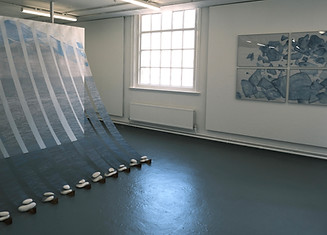
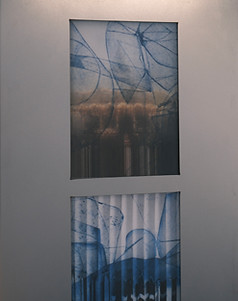
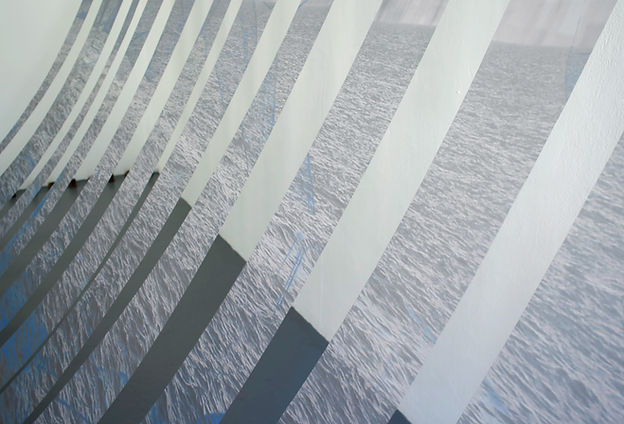
Held by the Tide explores the instability of boundaries and the fragile conditions through which ideas of home, protection and belonging are constructed. Bringing together textile, photography, painting, found objects and a small metal structure, the installation considers boundaries not as fixed lines, but as shifting conditions continuously shaped by movement, memory and lived experience.
The work begins with traces left by the sea. Stones appear to resist or hold back the tide, yet they can never stop the movement of water. Their apparent stability is always temporary, gradually altered by erosion, pressure and repetition. Similarly, wooden door wedges suggest control, protection and the desire to fix a threshold in place, but they can only do so for a limited period of time. These objects reveal the limits of human attempts to create permanence within unstable environments, while questioning whether security can ever be fully secured.
Throughout the installation, blue connects different materials and surfaces. It recalls the sea, but also carries associations of distance, memory, movement and emotional uncertainty. Rather than functioning simply as a visual motif, it allows separate elements to remain connected while retaining their individual material qualities.
The work also reflects on the tension between cultural systems and individual experience. Ideas of identity, territory and belonging are often organised through relatively stable categories such as inside and outside, home and elsewhere, familiarity and displacement. Yet lived experience rarely remains within these clear divisions. Memory, migration and adaptation continually shift the way a person relates to place.
Rather than rejecting boundaries altogether, Held by the Tide asks whether they can become more permeable, responsive and adaptable. Home is therefore presented not as a fixed geographical destination, but as a fragile psychological condition—something temporarily constructed through objects, memories and everyday experience, and continually reshaped by uncertainty, displacement and change.
《被潮汐托住》探讨边界的不稳定性,以及“家”、保护与归属感如何在不断变化的环境中被建构。作品结合纺织、摄影、绘画、现成物与小型金属结构,将边界理解为一种持续变化的状态,而不是固定不变的界线。它受到运动、记忆与个体生活经验的不断影响,也始终处在被重新定义的过程中。
作品从海水留下的痕迹出发。石头看似能够抵挡或托住潮汐,却永远无法真正阻止水的流动。它所呈现出的稳定只是暂时的,并会在反复的冲刷、侵蚀和压力中逐渐发生改变。木质门楔同样带有控制、保护以及固定门槛的意味,但它也只能在有限的时间内维持这种状态。这些物件揭示了人在不稳定环境中试图建立永久秩序时的局限,同时也进一步追问:安全感是否真的能够被固定和掌控。
蓝色贯穿整件装置,连接不同的材料与表面。它首先指向海洋,同时也关联着距离、记忆、流动以及一种难以被完全确定的情绪状态。蓝色在这里并不仅仅作为一种视觉上的统一元素,而是让彼此独立的物件在保持自身材料特性的同时,形成一种持续的联系。
作品同时关注文化体系与个体经验之间的张力。身份、地域与归属常常被组织为相对稳定的类别,例如内部与外部、家与异乡、熟悉与陌生,但真实的生活经验往往无法完全进入这些清晰的划分之中。记忆、迁移与适应不断改变个体与空间之间的关系,也使“归属”本身成为一种持续协商的过程。
《被潮汐托住》并非试图否定边界,而是在思考边界是否能够变得更加具有渗透性、回应性与适应性。作品中的“家”因此不再是一个固定的地理目的地,而是一种脆弱而暂时的心理状态。它通过物件、记忆与日常经验被不断建立,也在不确定性、迁移与变化之中持续被扰动和重新塑造。