A Different Kind of Happiness
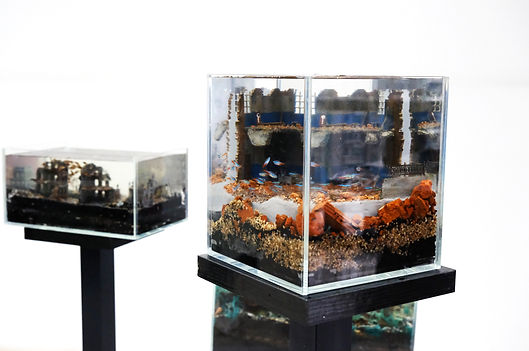
Fish tank installation, model
120cm*200cm*160cm
This work is inspired by residents living in unfinished buildings within the city. An unfinished building once carries the promise of home, development and future life. Yet when construction is suspended, it becomes a space caught in between: no longer simply a construction site, but not yet a home; not quite a ruin, but already marked by failure and abandonment.
Taking the unfinished building as its central image, the work explores the relationship between social structures, human survival and living space. It focuses not only on damaged architecture, but also on the people who are forced to continue their everyday lives within these incomplete spaces. Here, “home” loses its sense of safety, stability and completion. It becomes a temporary form of survival inside a ruin.
The work is composed of four fish tanks in different forms, each containing models of unfinished buildings. The structures are disordered, broken and incomplete, made from discarded materials and construction waste. These materials carry traces of abandonment, destruction and reuse, turning the models into condensed versions of real urban ruins.
The fish tank functions as both a container and a barrier. It separates the inner world from the outside, while allowing viewers to observe it closely. This creates a miniature landscape, where the reality of unfinished buildings is compressed into a small, almost surreal environment. The faint light inside the work brings a fragile brightness to the damaged space. It does not offer simple hope, but suggests a weak yet persistent force of survival.
Through the contrast between broken architecture, transparent containers, discarded materials and subtle light, the work reflects on the failures of contemporary urban development. It asks how people continue to live when housing loses its promise, and whether reconstruction and renewal are still possible within spaces shaped by abandonment.
这件作品的灵感来自城市中生活在烂尾楼里的居民。烂尾楼曾经承载着关于家、发展和未来生活的承诺。然而,当建设被迫中止,它便成为一种悬置的空间:不再只是施工现场,却也尚未成为真正的家;不完全是废墟,却已经带有失败与遗弃的痕迹。
作品以烂尾楼作为核心意象,探讨社会结构、人的生存处境与居住空间之间的关系。它关注的不只是建筑的破损状态,更是那些被迫在未完成空间中继续日常生活的人。在这里,“家”失去了安全、稳定和完整的意义,转而成为一种在废墟内部临时维持的生存状态。
作品由四个不同形态的鱼缸组成,每个鱼缸中都放置着烂尾楼模型。建筑结构错乱、断裂而残缺,由废弃材料和建筑垃圾拼接而成。这些材料本身携带着被遗弃、被破坏和被重新利用的痕迹,使模型成为现实城市废墟的浓缩版本。
鱼缸在作品中既是容器,也是屏障。它将内部世界与外部空间隔开,同时又允许观者近距离观看其中的细节。这种设置创造出一种微缩景观,将烂尾楼的现实压缩进一个小型、近乎超现实的环境之中。作品内部微弱的光线为破损空间带来一丝脆弱的明亮。它并不提供简单的希望,而是暗示一种微弱却持续存在的生存力量。
通过破碎建筑、透明容器、废弃材料与微光之间的对比,作品反思当代城市发展中的失效与断裂。它追问的是:当居住空间无法兑现它曾经许诺的未来时,人如何继续生活?在被遗弃所塑造的空间中,重建与重生是否仍然可能?