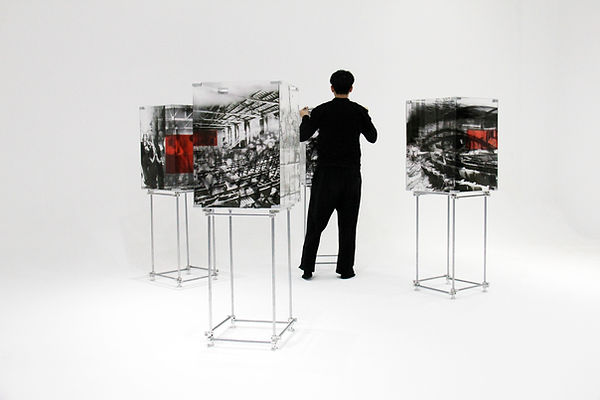
A Place of Interlocking
Photographic print, installation
Dimensions variable
A Place of Interlocking explores the relationship between non-place, spatial memory and the instability of identity in contemporary urban life. The work begins from the idea that many spaces today are no longer strongly connected to history, emotion or a stable sense of belonging. They become functional, anonymous and interchangeable, places to pass through rather than places to inhabit.
For me, the non-place is not simply empty. It reflects a psychological condition. In these spaces, the individual may be physically present, but emotionally unanchored. The work considers how people project memory, feeling and identity onto environments that seem temporary, neutral or difficult to belong to.
Through the construction and transformation of physical space, the work presents space not as a fixed container, but as a shifting field of relations. Forms overlap, connect and press against one another, suggesting that identity is also unstable and continually reconfigured.
The idea of “interlocking” carries both connection and tension. It suggests things coming together, but also being held or trapped within a structure. In this sense, A Place of Interlocking reflects on how contemporary urban space can make us feel connected and displaced at the same time.
《A Place of Interlocking》探讨“非场所”、空间记忆与当代城市生活中身份不稳定性之间的关系。作品从这样一种观察出发:今天的许多空间已经不再与历史、情感或稳定的归属感紧密相连。它们变得功能化、匿名化、可替换,更像是供人经过的地方,而不是可以真正栖居的场所。
对我而言,“非场所”并不只是空洞或无意义的空间。它更像是一种心理状态的映射。在这样的空间中,个体也许在身体上处于某个地点,却在情感上缺乏锚点。作品由此思考,人如何将记忆、情绪和身份投射到那些临时、中性,或难以产生归属感的环境之中。
通过对物理空间的建构与转化,作品并不把空间视为一个固定的容器,而是将其理解为一个不断变化的关系场。不同形态彼此重叠、连接、挤压,暗示身份本身也并非稳定完整,而是在移动、记忆和外部压力中持续被重组。
“Interlocking” 这一概念同时包含连接与张力。它意味着事物之间的相互嵌合,也暗示着被某种结构固定或困住的状态。因此,《A Place of Interlocking》所关注的,正是当代城市空间中的矛盾经验:我们似乎不断被系统、路径和空间连接起来,却也同时感到漂浮、疏离和失去位置。


